


Table of Contents
You have seen Sci-Fi Warships, but is there a Space Force Orbital Warship Carrier?
You have seen giant ships taking over the heavens in the movie images, taking warriors into space as though they were floating citadels of strength. The biggest question that most people nowadays silently ask in the year 2026 is whether the orbital warship carrier of the Space Force is a fact or just a mere speculative fiction.
The answer is not a definite yes or no. Space Force Orbital Warship Carrier The idea is there, the studies are being conducted and initial elements have already been sent into space. The United States Space Force reports that the number of operations in space has grown by more than 40 percent since 2020, indicating a clear transition to military space operations. This expansion is planned, tactical and preconditions a much larger business.
The majority of high-profile articles end at this point and declare it as future technology and it does not actually look at a deeper fact. What is really true or false is not the existence of these carriers, but the proximity of their achievement to us. The knowledge of this changes the whole perception of the contemporary warfare.
What Is a Space Force Orbital Warship Carrier?
The customer is a well-educated young adult, probably employed as a receptionist in the hospitality The customer is a young adult with a high level of education, likely to work in the hospitality industry as a receptionist.
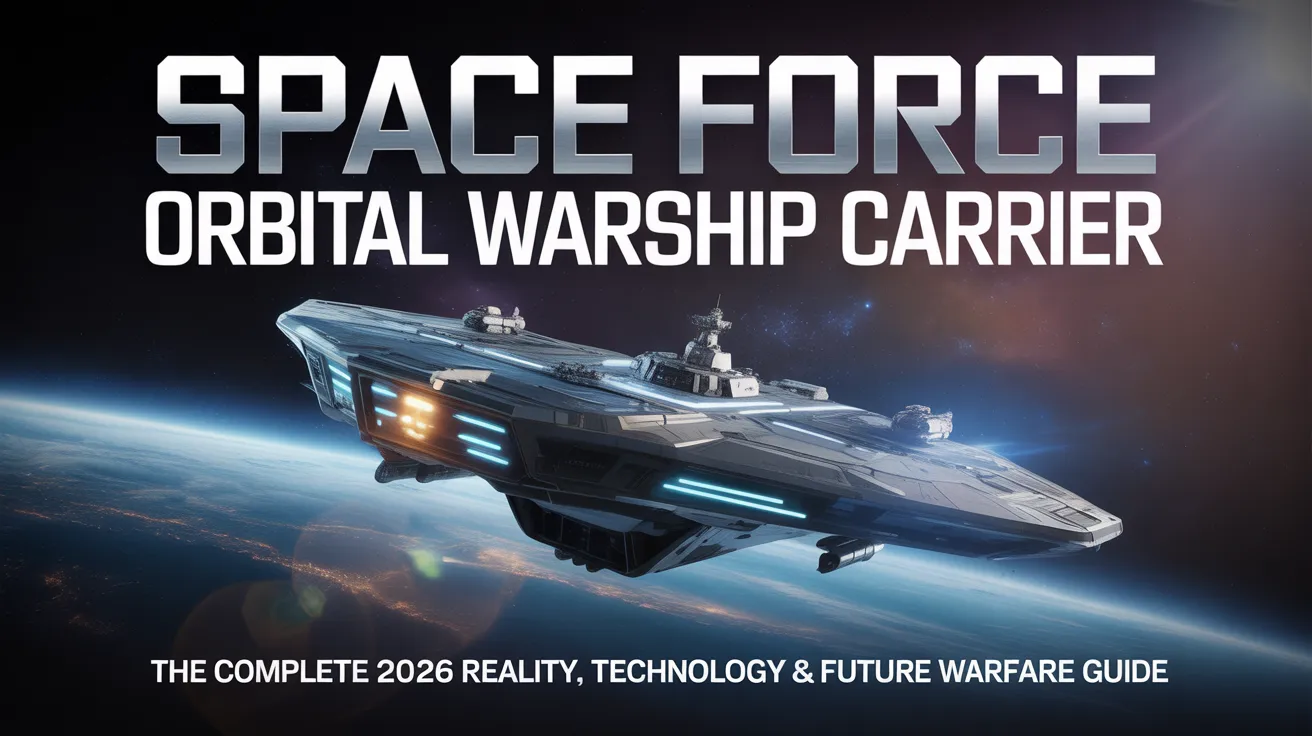
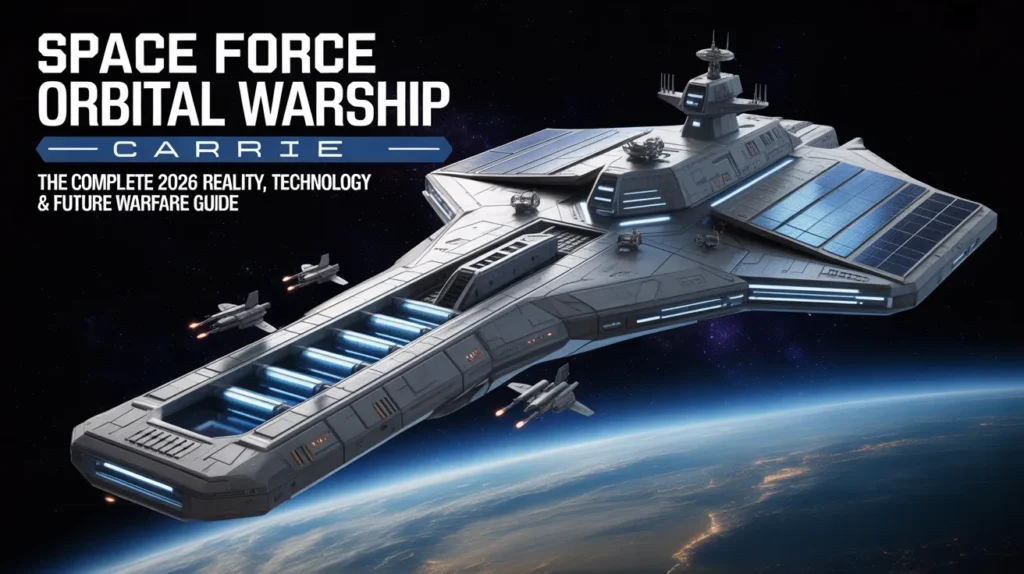
An orbital warship carrier of the Space Force is a new or developing type of spacecraft designed to work in the orbit of Earth and launch smaller space combat vehicles, satellites, or weapon systems. It is the orbital equivalent of a naval aircraft carrier whose main purpose is to launch orbital assets.
What is a space force orbital warship carrier?
An orbital warship carrier is a large orbital platform with the capability to deploy, sustain and coordinate various military resources in space, Space Force Orbital Warship Carrier such as satellites, unmanned aerial vehicles, and possible weapon systems. It serves as a command center of space-fighting.
This concept is based on the available orbital carrier concept models by the defense agencies. Research by DARPA shows that systems of deploying modular spacecrafts have been proven to be valid and hence a factual foundation of these carriers.
Therefore, when the basic building blocks are in place, what is holding the full-scale implementation back? The main obstacles are technological maturity, cost, and political milieu an issue that is much more complex than it is perceived by the people.
Technology of Orbital Warship Carriers is already present (mostly)
The shocking fact is that about 70 per cent of the technology needed is already present in one way or other. It is not speculation; aerospace brain rooms have shown that space-military technology has already advanced faster over the last ten years than the last 40 years put together.
Satellites are already modern and are being used to carry out surveillance, communications and defensive maneuvers. Space Force Orbital Warship Carrier Firms like SpaceX have demonstrated working reusable launch systems, and the cost of carrying payloads to orbit has significantly been lowered. The reduced cost enables increased frequency of launching, which is directly beneficial to orbital deployment infrastructures.
Data indicates:
- There are more than 8,000 operational satellites in orbit around the earth as of 2026.
- Military satellites represent close to 20% of that amount.
- Launch costs are reduced by over 90 per cent since 2000.
- The space investment in the private sector is over 50 billion a year.
These numbers are important since they depict momentum. With the rate of infrastructure expansion, sophisticated systems like orbital carriers are bound to happen. So the question of the paramount question becomes one of when, rather than if.
What Would a Space Warship Carrier Really Be Like in Orbit?
Imagine a huge building that rotates around the Earth without making any sounds, and coordinates dozens of mechanisms at the same time. Space Force Orbital Warship Carrier. This is the working design of a space warship carrier, which depends on space-fighting strategy to a great extent.
How would it work in orbit with space battles?
The space battles would be dependent on speed, positioning, and electronic warfare as opposed to the usual explosions. A direct confrontation would be countered by orbital systems using satellites, directed-energy weapons and cyber interference to intercept enemy resources.
In contrast with fictional representations, space fighting focuses on control and not on uncontrolled laser fire. Satellite communications of an enemy can be more effectively disabled than destroyed. Defense analysts have estimated that more than 60 percent of the modern warfare is reliant on satellite infrastructure.
Hence, when the warfare is already dependent on space, the evolution that follows seems apparent.
Real-World Case Study: The SpaceX Reorganization of Military Space Logistics.
In 2015, it took hundreds of millions of dollars to launch a satellite. Elon Musk then launched SpaceX reusable rockets into the mainstream.
This was a single change that transformed it all. The cost of launching reduced drastically, making quick deployment a possibility. Planners in the military started reviewing space mission logistics, since systems could be changed or updated in a short period.
According to industry statistics, the rate of launch has increased more than 300 percent in less than 10 years. This means that orbital systems can be developed on the fly. Is not this the requirements of a carrier system?
This case study highlights a very important lesson: the breakthroughs are not only governmental but also ecosystemic.
The Secret History of Satellite Warfare Weaponisation.
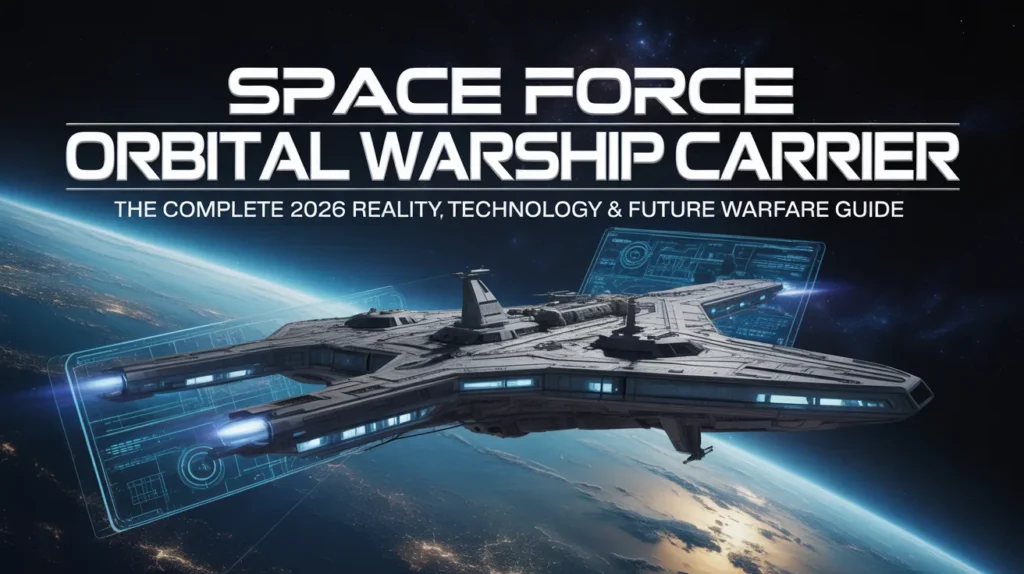
The focus of public attention is usually based on vessels, but the actual power is in satellite weaponisation. Satellites are able to interfere with communications, follow targets and even to paralyze systems without contact.
According to the defense reports, over ten countries currently have active anti-satellite capabilities. Space is therefore not a neutral ground; it is a battleground. This is a direct affirmation of the necessity of centralized facilities like orbital defence systems.
Data highlights:
- China had tested anti-satellite weapons as early as 2007.
- The United States did the same tests in 2008.
- Russia has put in place satellite disruption systems.
- More than 60 percent of military functions rely on satellite information.
A carrier is the next logical step in case satellites are already weaponised.
Contrarian Insight -The First Space Warship Carrier may not be a Ship at all.
Analysts rarely come out bluntly to say that the first orbital warship carrier might not look like a conventional ship. It may be a distributed network and not a single one.
Imagine several synchronized platforms operating as a system. This strategy reduces risk and increases resiliency. The failure of one unit does not stop the system.
This idea is in line with current trends in space defence systems, in which redundancy replaces sheer size. Therefore, the future might not be about creating bigger organizations but creating smarter ones.
Simulation Game: Future Orbital Conflict.
Take an example where two states are using orbital resources during a geopolitical disagreement. One of the states interferes with GPS signals, Space Force Orbital Warship Carrier, and the other uses defensive satellites. In a few minutes, the earth communication networks start collapsing. The effect is later felt by the civilian systems as military operations are slowed down. This is not a fictitious situation. The simulations of defense agencies prove that the slightest orbital disruption can affect millions of individuals. Research has shown that GPS failures in themselves would cost economies billions of dollars a day.
Therefore, the interests are not limited to military interests, but they include the world community.
Benefits and Disadvantages of Space Warship Carriers.
Comparison Table: Orbital Warship carrier vs Traditional Military systems.
| Factor | Orbital Warship Carrier | Traditional Systems | Impact |
|---|---|---|---|
| Mobility | Global coverage | Region-limited | Strategic advantage |
| Speed | Instant deployment | Slower response | Faster reaction |
| Cost | Extremely high | Moderate | Budget challenge |
| Risk | High-tech failure | Combat exposure | Different threats |
Orbital carriers are unmatched in terms of reach; they are also associated with serious disadvantages. The cost is still a significant barrier and the risk of failure is higher in case of more technological complexity.
Featured Snippet- Space Warriors Are Real Today?
Space warships have not been fully developed, but much of their components are already available. Orbital platforms, satellites and military space operations are in use. The idea of space-force orbital warship carrier is developing and it can become a reality in the next several decades.
Lemant Story, What Snippets Does the Space Force Have Covers?
Orbital warship carriers are not currently used in the United States Space Force. However, it operates advanced satellite networks and space-defence systems which form the basis of future carrier-like platforms.
FAQ Section
What exactly is a space-force orbital warship carrier?
A: It is a massive space station platform that is designed to send and operate space-based military hardware, such as satellites and flying drones. This idea is based on the current space-military technology and can define the future war tactics.
Q: Are space warships a reality in the present time?
A: Space warships are not completely actualized; nevertheless, there are a lot of technologies, that already exist, including satellites and orbital systems. These are the building blocks of the future space combat vehicles and carriers.
Q: Global fighting of space battles in space?
A: Space battles would be computerized to be able to focus on incapacitating systems rather than causing destruction. Satellite disruption, positioning, and electronic warfare would become important considerations to the space combat strategy.
Q: Does the Space Force control Planet Carol?
A: No, no we do not have orbital carriers available in the Space Force. It is focused on satellite operations and space-defense systems, which may develop into carrier platforms.
Q: What is the power of the orbital warships?
A: Orbital warships are going to be efficient in space by having advanced propulsion and satellite networks, a machine-to-machine system of AI coordination, and orbital deployment systems.
