


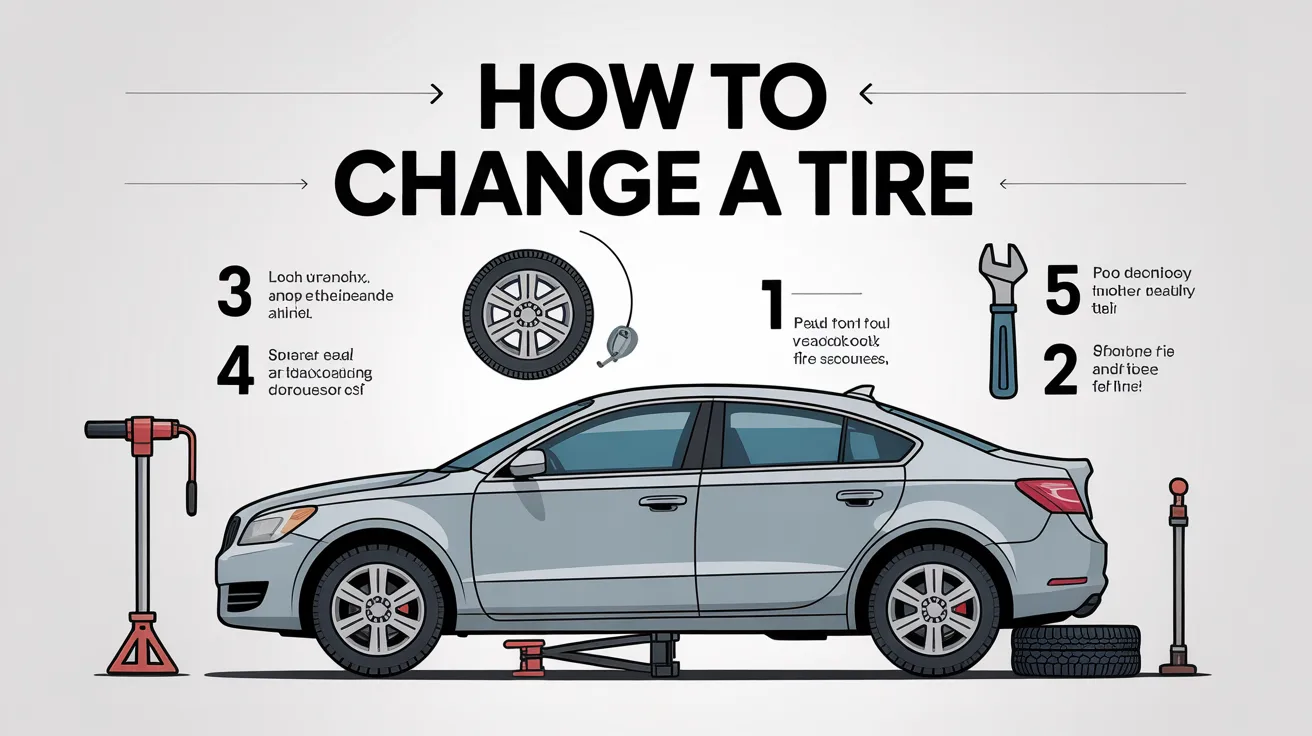
Table of Contents
You Have a Flat Tire – A Guide on How to Change a Tire
It also happens at the worst possible time: you are in a hurry, the highway is empty, and then your car turns to the right. A flat tyre is not just a nuisance; it could be so overwhelming to the extent that you have never dealt with it. However, most people overlook that learning to change a tyre is one of the most empowering and underestimated skills a driver can have.
The initial one is not to touch the tyre in question but to make sure that it is safe. Park on a steady and even area and turn on your hazard lights. This is an important element of vehicle safety processes, How to Change a Tire since most accidents occur during roadside stops rather than while vehicles are in motion. It is surprising to hear that an improper stop may be more dangerous than a flat tyre.
After parking safely, make sure to use the parking brake, and where you have, install wheel wedges. This simple measure eliminates the possibility of rolling of the vehicle particularly on small slopes. It is a small but essential step that professionals do not overlook, and it lays the groundwork for all the other steps.
Necessary Equipment Before Making Contact with the Tyre.
Most individuals assume that they can make it up, yet the truth of the matter is very grim, unless one has the right equipment, replacing a tyre is almost unfeasible. The usual kit is a jack, a lug wrench, and a spare tyre, but understanding how to utilise them is much more significant than owning them.
Which Equipment is needed to perform a Tyre change?
One needs a good car jack, a lug wrench, a spare tyre and hopefully a pair of gloves and a torch. With these products, you can raise the car, take off the lug nuts and fit the spare tyre with ease. Without them, the process will be unsafe and inefficient.
One of the less known facts that a beginner should not ignore is that the manual of the vehicle has the exact jack positioning points. The failure to pay attention to this information may harm the frame of the vehicle. When the right advice is already there, what is the use of incurring expensive repairs?
Read More: car maintenance checklist: basic car care rules and regulations
There is a Method to Changing a Tyre like a Pro.
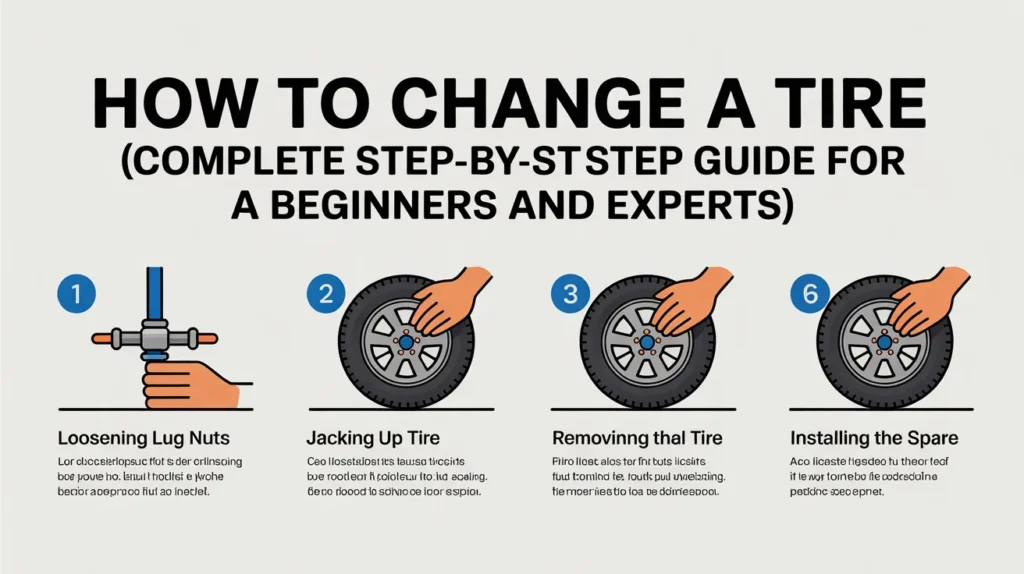
It does not need any mechanical skills, and what is a straightforward process. These are the steps to follow on changing tyres and you will be able to deal with the situation easily.
Tyre Changing Table Step-by-Step.
| Step | Action | Why It Matters | Common Mistake |
|---|---|---|---|
| 1 | Loosen lug nuts | Easier before lifting car | Tightening instead |
| 2 | Position jack | Prevents damage | Wrong placement |
| 3 | Lift vehicle | Creates clearance | Lifting too high |
| 4 | Remove tire | Prepares for spare | Losing lug nuts |
| 5 | Install spare | Restores mobility | Misalignment |
Start by loosening the lug nuts- do not take them out. This is an important measure in the removal of lug nuts that should be done when the tyre is on the ground to avoid spinning. It seems easy, but here most amateurs fail.
Then raise the car with the help of appropriate jack-raising methods. Just lift it to get the tyre out of the ground. One of the common errors is over-lifting which is both a waste of energy and an increase in risk.
Properly fitting the Spare Tyre (A Little Slip-up).
It is interesting to note that most of the errors happen when installing the spare tyre- not when taking out the flat tyre. Make sure that the spare fits into the wheel bolts and force it into the wheel bolts.
Tighten the lug nuts first by hand, and then slightly lower the vehicle then tighten the lug nuts completely. This process will guarantee an even distribution of pressure, which is a very critical aspect of appropriate spare tyre fitting. The question someone can ask is why some spare tyres are not stable; this is usually because of tightening them unequally.
Lastly, screw the nuts to a star shape. The method eliminates wobbling and provides stability in the long term.
Reality Test – How to change a tyre on a busy highway.
Imagine the following scenario: you are late in the night, traffic is passing by and you hear that terrible thump. One of the drivers told about panicking and rushing through the process, only to realise that they had not secured the vehicle. Such negligence would have been disastrous.
Visibility should be emphasised in high-risk scenarios. Wear reflective clothes and place warning triangles behind your car. Such emergency steps which are done along the roadside can actually save lives. Would you give another minute to prevent a serious accident?
This situation highlights a neglected fact; tyre changing is not a simple mechanical task, it requires situational awareness and accurate performance.
The Top Ten Mistakes that Can Turn a Tyre Change into a Nightmare.
Lots of online manuals do not include this necessary part, but the real mastership is here. The biggest error is to hurry the process. Haste will lead to slack wheels, broken threads, etc.
The other issue that has been overlooked is lack of concern on tyre condition. A spare tyre is to be used temporarily. Most drivers misuse it as a permanent one and thus, the integrity of the suspension is compromised in the long run. Did it not amaze you that a fix can turn out to be a long-term problem?
Contrarian Viewpoint- You Do Not Always have to change the Tyre Right Now.
Guides rarely speak about the fact that in some situations, replacing the tyre is not the best first step. In case you are in a risky area, it may be safer to stay in the car and call the police.
Professional drivers are habitual risk pre-assessors. This strategy dispels the notion that the tyre should always be repaired at all times. Speed will never triumph over safety- not at all.
Practice and Preparation: Acceleration of the Tyre Change.
Preparation is the difference between a stressful experience and the smooth one. Store your equipment, and practice the process at home. Yes–do before you need to.
Those drivers who practice the wheel-changing procedure are able to finish it in less than fifteen minutes. That is what lies between panic and confidence. Would you not rather be ready than make it up when you are in a jam?
Tips of the Trade: Only Experienced Drivers.
Flexible drivers always check the pressure of tyres after mounting. A deflated spare tyre may fail very quickly.
The other professional advice is to put the lug nuts that have been removed in a container or pocket. A single nut lost can cause a lot of delay on your way. Such minor practices make a difference among experienced professionals.
Snippet Featured Response to How to Change a tire.
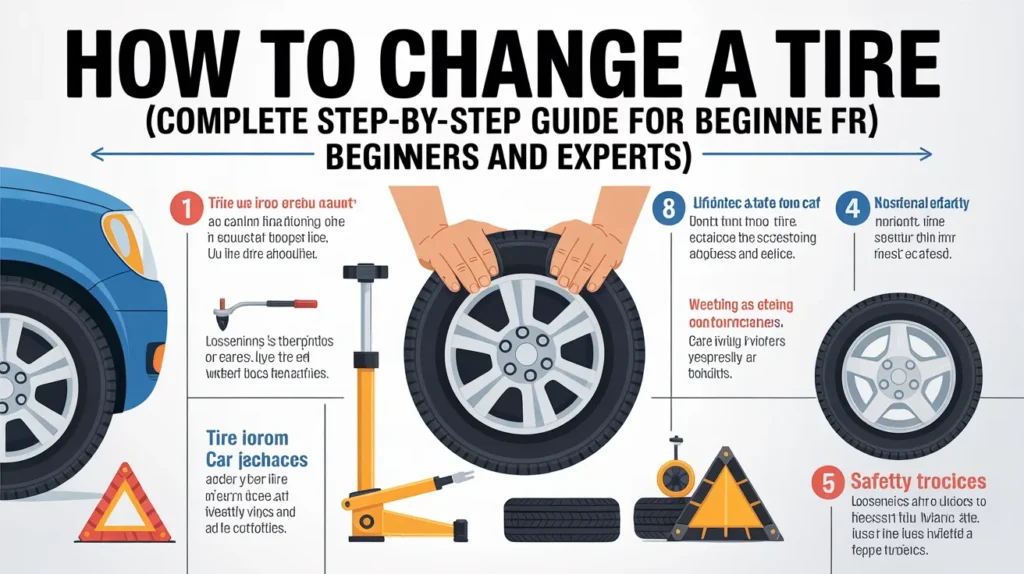
To change a tyre, one will need to find a safe parking space, loosen lug nuts, jack up the car, remove the deflated tyre, fit in the spare tyre, and screw the lug nuts tightly. One must always be careful and check the inflation of tires before taking off. This process normally occupies 15-30 minutes.
Featured Snippet: Why 2026 Learning This Skill Matters.
The reliance on roadside assistance is becoming more dangerous by 2026 because it may slow down or have limitations on coverage. Learning how to replace a tyre will ensure that one is more independent, responsive, and safer in case of an emergency.
FAQ Section:
Q: What are the steps related to changing a tire?
A: To change a tire, one should find a safe parking place, loosen the lug nuts, and use a jack to raise the car, remove the punctured tire, and put on the spare one and screw the nuts. This sequential manual is safety and efficiency-oriented when dealing with roadside emergencies.
Q: Which time do you take to replace a tire?
A: The usual time spent on conventional tire replacement is between 15 to 30 minutes and this is based on experience and the conditions that one is working in. Proper tools and enough practice can ensure that the process is done more safely and quickly.
Question: What are the tools required to change a tire?
A: The necessary equipment is a car jack, lug wrench, spare tire, and such safety accessories as gloves. These products play a vital role in the proper replacement of tires and safety of vehicles.
Q: Can I change a tire by myself?
A: Yes, even a good driver is capable of changing a tire on his/her own, as long as all the suggested procedures and safety measures are followed. Many people can handle flat tire repairs without the help of a professional.
Q: Is changing a tire on the road safe?
A: It is safe provided that some precautions are taken, i.e. the use of hazard lights, a level parking area and visibility. The safety of the road is paramount when changing tires in case of an emergency.
