


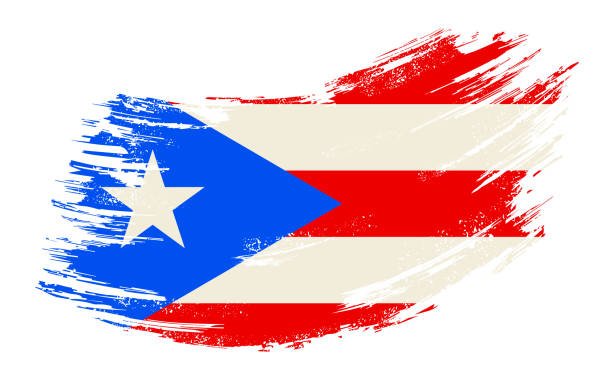
One of the national symbols (Caribbean) that is most popular in the Puerto Rican flag. Its red and white stripes, blue triangle, and bright white star symbolize identity, resistance, and cultural pride.
However, the design is not merely ornamental. All the elements are history, political conflict and the soul of the island.
The flag is much more than a territory to the Puerto Ricans. It represents the past, nationalism, and intergenerational unity.
You will learn in this comprehensive guide:
- The history of the Puerto Rican flag.
- The symbolism and meaning of its colors.
- The way the design changed over the years.
- The importance of the flag to Puerto Ricans.
- Some false assumptions about the flag.
In the end, you will be able to see why this flag still evokes millions of people around the world.
What Is the Puerto Rican Flag?
Puerto Rican flag is the national flag of Puerto Rico. It features:
- Five horizontal stripes
- A hoist side blue triangle.
- The triangle contains five white points of a star.
The motto is very similar to the Cuban flag. The same is made on purpose.
The two flags came about during the late nineteenth century in the movement of independence.
The Puerto Rican revolutionaries desired that the flag should be used to demonstrate their solidarity with the struggle in Cuba to overthrow colonial rule.
The flag is now a symbol of culture, endurance and pride to the Puerto Ricans on the island and the diaspora in general.
History of Puerto Rican Flag.
Independence Movement Origins
The Puerto Rican flag was originally designed in the year 1895 by the members of Puerto Rican Revolutionary Committee in New York.
Such influential personalities were incorporated in this committee as Ramon Emeterio Betances and Juan de Mata Terreforte.
They aimed at creating a Puerto Rican identity that was independent of Spain.
It was designed based on the Cuban flag but in reversed colors.
This visual association presented the common ideals of revolution among the two islands.
First Public Use
The flag was initially made during the Yauco Intentona.
The rebellion did not succeed, but the flag was a permanent symbol of struggle.
In the future, Puerto Rico was conquered by the U.S. after the Spanish-American War.
Decades on, the Puerto Rican flag had been prohibited from being displayed.
Legal Recognition
The government of Puerto Rico officially adopted the flag in 1952.
This was parallel to the formation of the Commonwealth of Puerto Rico.
The flag has since then been extensively utilized in government, sporting and cultural occasions.
The Puerto Rican flag has design aspects that include its design.
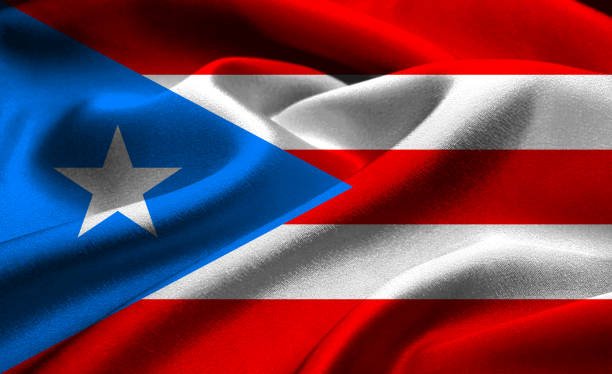
The design has a number of symbolic elements.
All of them have values that are significant to the Puerto Rican society.
1. The White Star
The white star is one, and it symbolizes the Commonwealth of Puerto Rico.
It is representative of the island as a whole and the unity of people.
The star is a symbol of direction and hope as well.
2. The Blue Triangle
The three arms of government are represented by the blue triangle:
- Executive
- Legislative
- Judicial
These institutions are the cornerstones of democracy.
The triangle is also an improvement in the ideals of liberty and republicanism.
3. The Red Stripes
There are three red stripes in the flag.
These are the blood that feeds the government and makes it strong.
They are also symbols of the bravery of the people who fought for freedom.
4. The White Stripes
The peace and victory are symbolized by two white stripes.
They are symmetrical in the red lines and mirror the need to have harmony and justice.
Symbolism of the Colors
The Puerto Rican flag has a very strong symbolism of color.
A simplified description of each of the colors is given below.
| Color | Symbolism | Cultural Meaning |
| Blue | Sky and seaside waters | Freedom and the state |
| Red | Power and pain and gain | Patriotism |
| White | Support and liberty | Balance and unity |
These definitions can be used to understand why the flag is so appealing to Puerto Rican communities.
Breaking Down the Puerto Rican Flag Design.
The following layout would be of interest to gain a clear picture of the design structure.
Chart of Distribution by Flag Elements.
Puerto Rican Flag Element Composition
Red Stripes ███████████████████ 60%
White Stripes ████████████ 25%
Blue Triangle ███████ 12%
White Star ██ 3%
The Puerto Rican Flag is not a Flag of Despair.
The Puerto Rican flag is still very significant in the contemporary world.
It appears at:
- Cultural festivals
- Sporting events
- Political demonstrations
- Music concerts
- Community celebrations
Performers, musicians, and sportsmen often use the flag to rejoice in identity.
Indicatively, the use of the flag has been featured by global artists such as Bad Bunny in their performances to showcase the Puerto Rican culture.
On the same note, the Puerto Rican athletes wear the flag during international events.
These instances strengthen the international presence of this symbol.
Puerto Rican Flag vs the Cuban Flag
Due to their common past, the Puerto Rican flag tends to be compared with the Cuban flag.
Here is a clear comparison
| Characteristic | Puerto Rican Flag | Cuban Flag |
| Triangle | Color Blue | Color Red |
| Star | White star blue triangle | White star red triangle |
| Stripes | Red and white | Blue and white |
| Motivation | Cuban revolution movement | Original revolutionary design |
Although there is a visual similarity, the similarity in the symbolism is somewhat different.
All the flags symbolize their own political background and cultural identity.
History of Puerto Rican Flag Colors.
The color blue, which was used in the Puerto Rican flag, has evolved.
The triangle was initially light sky blue.
The shade, however, changed to a darker navy blue after official adoption in 1952.
Historians have felt that the darker tone made the flag match standards of the U.S flag.
Over the past few years, there have been certain groups that support the reversion to the light shade of the early revolutionaries.
This discussion is a reflection of more general debates of identity and political status.
How to draw Puerto Rican Flag: step by step.
The process of making the Puerto Rican flag is not hard, provided that you take a systematic method.
Step 1: Draw the Rectangle
Begin with a rectangle that is horizontal in shape.
The majority of flags have a ratio of 2: 3.
Step 2: Divide the Stripes
Draw five horizontal stripes of all sizes.
Arrange them in this order:
- Red
- White
- Red
- White
- Red
Step 3: Add the Triangle
On the left side, draw a blue triangle.
The base of the triangle is to be extended all over the height of the flag.
Step 4: Insert the Star
In the middle of the triangle, put a white five-pointed star.
Enhance the symmetry of the star.
These steps will keep the design on the right track.
The most frequent errors when wearing the Puerto Rican Flag.
The flag is misused by a lot of people unknowingly.
These are the pitfalls that should be avoided.
Incorrect Color Shades
The symbolism is altered with the use of excessively dark or wrong colors.
Always with conventional red, white, and blue.
Flipping the Flag
In some cases, individuals switch the direction.
The triangle should always be positioned on the left.
Distorting the Proportions
The triangle or stripes, when stretched destroys the design.
Authenticity is achieved through proper proportions.
Designer Pro Tips that Designers forget.
There are usually unspoken rules of design, which professionals dealing with the Puerto Rican flag are inclined to exercise.
The tips are used to sustain visual accuracy.
Keep the stripe thickness equal.
The flag appears distorted in regular stripes.
Center the star carefully.
Even at a small size, it is clear that misalignment occurs.
Print using vector graphics.
Vectors maintain the clarity in banners and digital media.
There should be no unnecessary shadows or gradients.
Conventional flags are made with flat colors.
Puerto Rican Flag and its cultural significance.
The flag has been a symbol of unity to Puerto Ricans in the entire world.
There are large Puerto Rican neighborhoods in such cities as:
- New York City
- Orlando
- Chicago
The flag is a central point of celebration during the cultural events.
The National Puerto Rican Day Parade is one of them.
Millions of participants and spectators attend this parade per year.
During the celebration, the streets are dominated by the flag.
Puerto Rican Flag in Contemporary Pop Culture.
Puerto Rican flag is common in entertainment and fashion.
Musicians, filmmakers, and designers make use of the symbol to symbolize heritage.
Streetwear companies tend to incorporate the flag in their lines.
They have been displayed by musicians such as Daddy Yankee and Ricky Martin when they perform around the world.
These scenes help in strengthening the Puerto Rican cultural pride.
Frequently Asked Questions
What is the symbolism of the Puerto Rican flag?
The Puerto Rican flag represents the sense of freedom, unity, and national identity.
Its colors are the symbol of sacrifice, peace, and the democratic government.
What is the date of creation of the Puerto Rican flag?
The work was designed by the Puerto Rican revolutionaries in New York in 1895.
Why is the Puerto Rican flag resemble the Cuban flag?
The design is a deliberate replica of the Cuban flag to be able to show unity in the independence movements.
Is it permissible to fly the Puerto Rican flag?
Yes. The Puerto Rican flag is now commonly exhibited throughout the island and in other parts of the world.
What is the meaning of the white star in the Puerto Rican flag?
The white star is the symbol of unity and the people of the island of Puerto Rico.
The Final Reflections of the Puerto Rican Flag.
The Puerto Rican flag is not just a national flag.
It is symbolic of the past, strength, and ethnicity.
The flag still binds Puerto Ricans all over the world, regardless of the time of day or occasions.
Its design, symbolism, and history allow us to appreciate its sense even more.
The flag is a potent symbol of pride, whether one notices it in the festivals, sports arena or cultural events.
To most people, it is an account of ancestry, hardship, and a promise of better days.
